

Lead
- Lead is not found free in nature and is usually extracted from galena, which is found in veins and masses in crystalline rocks.
- Lead is malleable, soft, heavy, and a bad conductor of electricity.
- It is used as an anti-friction metal and a constituent in bronze alloys.
- Lead oxide is used in cable covers, ammunition, paints, glass making, and the rubber industry.
- It is also made into sheets, tubes, and pipes for use as sanitary fittings and is increasingly used in automobiles, airplanes, and calculating machines.
- Lead nitrate is used in dyeing and printing.
Reserves:
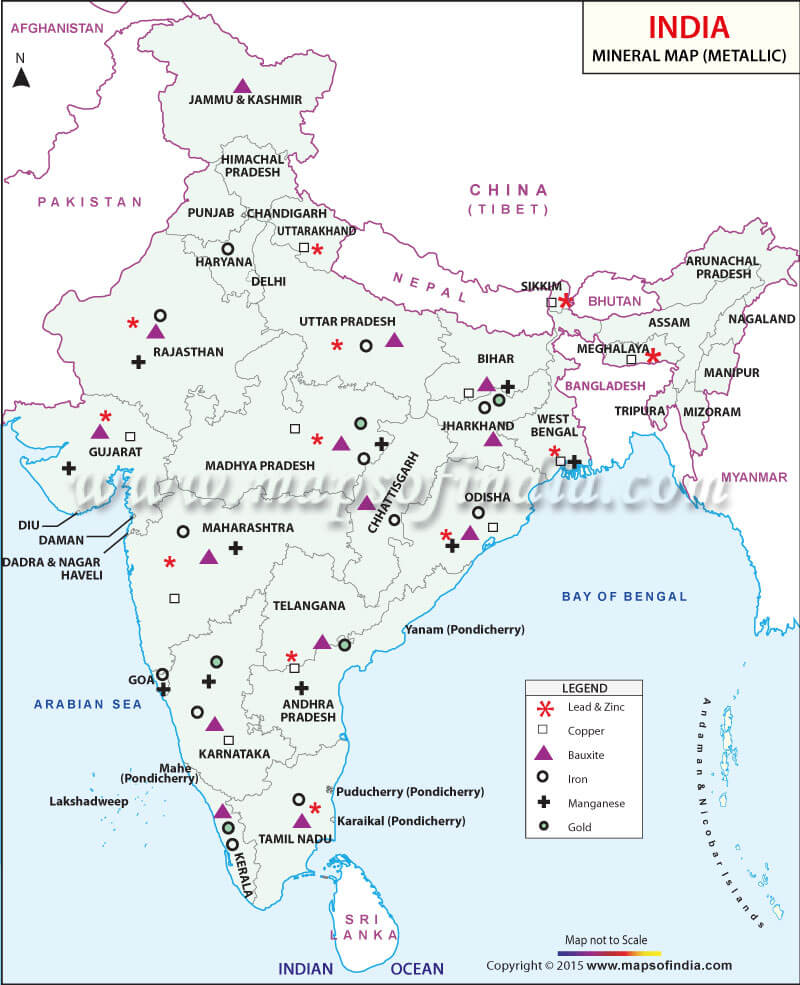
- Lead ores are found in the Himalayas, Tamil Nadu, Rajasthan, and Andhra Pradesh.
Mines:
- Rajasthan produces about 94% of India’s total lead production, with major producers including the Zawar and Debari mines in Udaipur, as well as Dubgarpur, Banswara, and Alwar.
- The Kurnool and Nalgonda mines in Andhra Pradesh are also known for lead mining.
Zinc
- Chief ore of zinc is sphalerite (ZnS) found in veins with other ores like galena, chalcopyrite’s and iron pyrites
- Zinc is a mixed ore containing lead & zinc
- Mainly used for alloying and manufacturing galvanized sheets
- Zinc dust used for preparation of zinc compounds and salts
- Zinc oxide used in paints, ceramic material, inks, matches, etc.
- Used for dry batteries, electrodes, textiles, die-casting, rubber industry, and making collapsible tubes
Reserves
- Rajasthan produces over 99% of total zinc production in India
- Zawar mines in Udaipur district responsible for production, deposits also found in Sikkim
Imports
- India imports zinc concentrates from USA, Canada, Zimbabwe, Japan, and Mexico
- India also imports zinc concentrates from Australia, Peru, Russia, and Zaire
Tungsten
- Tungsten ore includes wolframite, scheelite, and ferberite, which are predominantly hydrothermal in origin
- Tungsten is resistant to all acids at ordinary temperatures and has a melting point of 3422oC, the highest of all metals
- Over 95% of tungsten is used by the steel industry, mainly in the form of ferrotungsten
- Steel containing tungsten is used in manufacturing ammunition, armour plates, heavy guns, hard cutting tools, etc.
- Tungsten is easily alloyed with other metals to yield hard-facing, heat, and corrosion-resistant alloys
- Tungsten is also used for electric bulb filaments, paints, ceramics, textiles, etc.
- Resources:
- Resources of tungsten are mainly distributed in Karnataka, Rajasthan, Andhra Pradesh, and Maharashtra in India
- Imports:
- Domestic requirements are met by imports, mainly from Singapore, USA & UK
- Exports:
- Exports are mainly to Germany, USA, Israel, UK, Japan, and Sweden.
Pyrites
- Pyrite is a sulphide of iron.
- Chief source of sulphur.
- High proportion of sulphur is injurious to iron. Hence is it removed and used to produce sulphur.
- Sulphur is very useful for making sulphuric acid which in turn is used in several industries such as fertilizer, chemicals, rayon, petroleum, steel, etc.
- Elemental sulphur is useful for manufacturing explosives, matches, insecticides, fungicides and for vulcanizing rubber.
- Pyrites occur in Son Valley in Bihar, in Chitradurga and Uttar Kannada districts of Karnataka and the pyritous coal and shale of Assam coalfields.
- It is widely distributed and scattered across the country.